The Test of Time: How an Ultrasonic Rhinoplasty Performed Fifteen Years Ago by Dr. Cariñanos Has Aged
Dr. Pablo Cariñanos
Rhinoplasty specialist
Summary
In facial aesthetic surgery, the real test isn’t passed when the dressing comes off, but ten or fifteen years later. That is when you find out whether an operated nose has held its shape, whether the tip is still where the surgeon left it and whether the profile is ageing in harmony or starting to […]
In facial aesthetic surgery, the real test isn’t passed when the dressing comes off, but ten or fifteen years later. That is when you find out whether an operated nose has held its shape, whether the tip is still where the surgeon left it and whether the profile is ageing in harmony or starting to betray itself. So when a patient who had surgery a decade and a half ago sits down again in clinic and the examination confirms that the result remains intact, the case is worth pausing over.
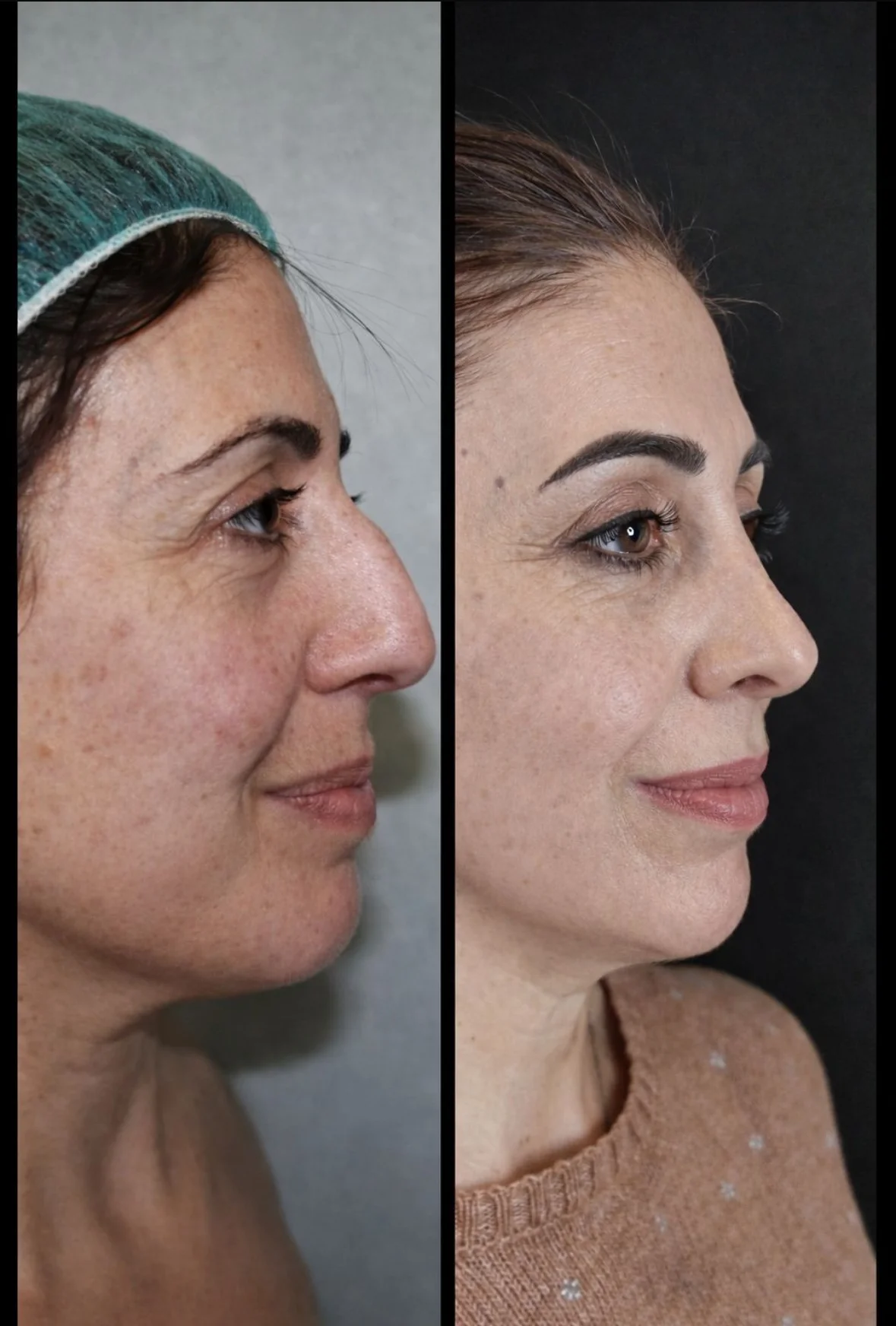
At Dr. Cariñanos’s practice in Seville, this kind of long-term follow-up has quietly built up into a fairly eloquent archive. One particularly representative example involves a patient who underwent ultrasonic rhinoplasty fifteen years ago. The nasal framework is still firm, the dorsum has kept its straight line and the tip has neither dropped nor lost definition. For anyone weighing up the technique, this is precisely the question they want answered: does it hold up over time?
Ultrasonic rhinoplasty uses high-frequency instruments to sculpt the bone with millimetric precision, without traumatising the surrounding soft tissue. The immediate benefit, familiar to most patients, is a gentler recovery: less bruising, less swelling and a faster return to normal life. The long-term benefit, less talked about but equally relevant, has to do with structural integrity. By respecting the internal architecture of the nose, the technique reshapes without weakening, and that explains why these results tend to age better than those of many classic rhinoplasties, where a dropping tip or a loss of support used to be a legitimate concern from the first decade onwards.
To that stability comes an aesthetic advantage many patients consider non-negotiable: the absence of visible scarring. Incisions are placed inside the nose, leaving no external marks on the face. Fifteen years later, in this particular case, there is no perceptible sign that the patient has been through surgery, and that invisibility isn’t simply a matter of the early postoperative months: it holds up after the skin has continued to age naturally.
Behind the result lies a technical philosophy that Dr. Cariñanos has championed for years: rhinoplasty should be conservative and structural, not aggressive. The aim isn’t to hollow out the nose in order to reduce it, but to reorganise and reinforce its internal support while refining the outer silhouette. It is an approach that demands more planning beforehand and more time in theatre, but it translates into what this patient confirms with her own anatomy a decade and a half later: a nose that still functions well, still looks natural and hasn’t «shifted».
The clinic’s location in Seville also makes it straightforward for patients from Madrid, Barcelona and abroad to combine surgery with a calm recovery in a well-connected city with solid medical infrastructure. What really sets the process apart, though, is the preoperative assessment: every nose, every skin type and every set of facial features calls for a different plan, and Dr. Cariñanos’s team always begins with an individual study before proposing anything. An initial consultation, in person or online, is usually enough to understand what the technique can and cannot deliver.
Cases like this aren’t a universal guarantee; no surgical result ever is. But they do offer something hard to manufacture: real evidence of how an ultrasonic rhinoplasty behaves once enough years have gone by for any structural weakness to have shown itself. In this case, it hasn’t.